
The Growing Challenge of Accessing Enterprise Information
Every organization runs on multiple systems.
Customer information lives in CRM platform. Financial data resides in ERP systems. Operational insights are spread across dashboards and databases.
Important knowledge often sits inside documents, emails, and collaboration tools.
As businesses grow, so does the complexity of accessing information.
Employees spend a significant amount of time switching between applications, searching for reports, and requesting information from different teams. Leaders often have the data they need, but finding the right answer at the right time can still be difficult.
What if employees could simply ask:
- What were our sales figures last quarter?
- Which customers have overdue invoices?
- What is our current inventory position?
- Why did revenue decline in a particular region?
And receive accurate answers instantly?
Leaders are increasingly using AI assistants to get instant answers to critical business questions. Explore these 10 business questions every leader should ask an AI assistant to see how conversational intelligence supports better decision-making.
This is exactly what an Enterprise AI Assistant is designed to do.
Enterprise AI assistants are transforming the way organizations interact with data, applications, and knowledge. Rather than navigating multiple systems, users can access information through natural language conversations, making enterprise intelligence more accessible than ever before.
In this guide, we’ll explore what an enterprise AI assistant is, how it works, the technologies behind it, and why it is becoming an essential part of modern business operations.
What Is an Enterprise AI Assistant?
An Enterprise AI Assistant is an AI-powered platform that enables employees to interact with business applications, enterprise data, and organizational knowledge through natural language conversations.
Instead of manually searching through reports or switching between systems, users can ask questions and receive contextual answers instantly.
For example:
– Show me sales performance for the last six months.
– Which customers are at risk of churn?
– What is the status of pending purchase orders?
– Summarize our operational performance this quarter.
The assistant understands the request, retrieves information from connected systems, analyzes relevant data, and delivers meaningful responses.
Unlike consumer AI chatbots that answer general questions, enterprise AI assistants are built specifically for business environments. They securely connect to enterprise applications and deliver information tailored to organizational needs.
Think of an enterprise AI assistant as an intelligent layer that sits across your business systems and enables people to access information simply by having a conversation.
To see a real-world example of how an enterprise AI assistant connects business data, applications, and knowledge into a single conversational experience, explore Cazper, an AI-powered Business Intelligence Assistant.
Why Enterprise AI Assistants Are Becoming Essential
Organizations today generate enormous amounts of information every day.
Data exists across:
– ERP systems
– CRM platforms
– Financial applications
– Data warehouses
– Customer support tools
– Collaboration platforms
– Documents and knowledge repositories
Despite this abundance of information, employees often struggle to find answers quickly.
Several challenges are driving the adoption of enterprise AI solutions.
1. Information Is Fragmented
Business information rarely exists in one place. Employees frequently need to access multiple systems to answer a single question.
2. Decision-Making Needs to Be Faster
Markets change rapidly. Leaders need immediate access to insights to respond effectively.
3. Employees Expect Consumer-Like Experiences
People are increasingly accustomed to conversational interfaces and expect enterprise systems to be equally intuitive.
4. Businesses Want Greater Productivity
Teams spend too much time searching for information rather than acting on it.
5. Data Should Be Accessible to Everyone
Information should not be limited to technical teams or business analysts. Every employee should be able to access insights when needed.
Enterprise AI assistants address these challenges by making enterprise information easier to access and use.
How Does an Enterprise AI Assistant Work?
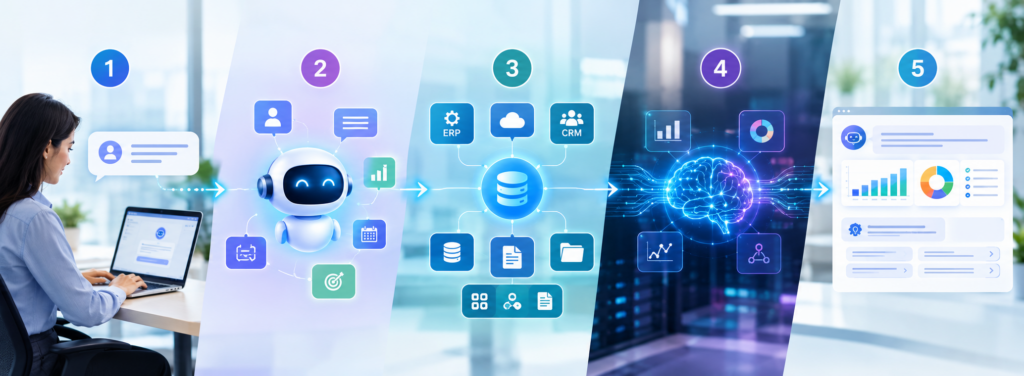
Although using an enterprise AI assistant feels simple, sophisticated technologies operate behind the scenes.
Step 1: The User Asks a Question
The interaction begins with a natural language question.
For example:
“Which products generated the highest revenue last quarter?”
Step 2: The Assistant Understands Intent
Using Natural Language Processing (NLP), the assistant interprets:
– User intent
– Business terminology
– Relevant metrics
– Time periods
– Context
The system understands not just words, but what the user is trying to achieve.
Step 3: Information Is Retrieved
The assistant securely connects to business systems, including:
– ERP applications
– CRM platforms
– Databases
– Data warehouses
– Documents and knowledge bases
– Business applications
Relevant information is gathered from these sources.
Step 4: The Information Is Processed
Artificial intelligence analyzes the data, performs calculations, identifies relationships, and generates insights.
Step 5: A Response Is Delivered
The assistant presents information in a conversational format, often including:
– Direct answers
– Summaries
– Charts and visualizations
– Recommendations
– Suggested follow-up questions
The entire experience feels similar to having a conversation with an intelligent business analyst.
Core Technologies Behind Enterprise AI Assistants
Modern enterprise AI assistants combine multiple technologies to deliver intelligent experiences.
Large Language Models (LLMs)
Large Language Models help the assistant understand natural language and generate human-like responses.
Natural Language Processing (NLP)
NLP enables the assistant to interpret questions, understand context, and recognize business terminology.
Retrieval-Augmented Generation (RAG)
RAG allows the assistant to retrieve information from enterprise systems and knowledge repositories before generating responses.
This improves accuracy and ensures answers are grounded in organizational data.
Machine Learning
Machine learning algorithms identify patterns, improve recommendations, and enhance the assistant’s capabilities over time.
Data Integration Frameworks
Integration technologies connect the assistant with ERP systems, CRM applications, databases, and other enterprise platforms.
Together, these technologies make enterprise AI assistants capable of delivering contextual and reliable business intelligence.
Enterprise AI Assistant Architecture
While implementations vary, most enterprise AI assistants include five core layers.
Conversational Interface
The user interacts through chat interfaces, web applications, mobile apps, or collaboration platforms.
Intelligence Layer
AI models process requests, understand intent, and generate responses.
Data Integration Layer
Connectors securely access information from enterprise systems.
Security and Governance Layer
Authentication, authorization, and access controls ensure users only view permitted information.
Analytics and Monitoring Layer
Administrators monitor usage, performance, and adoption while continuously improving the assistant.
This architecture allows organizations to unify information from multiple systems into a single conversational experience.
Enterprise AI Assistant Use Cases Across Industries
Finance
Finance teams use enterprise AI assistants to:
- Monitor cash flow
- Analyze expenses
- Track profitability
- Review outstanding receivables
Sales
Sales organizations use AI assistants to:
- Analyze pipeline performance
- Monitor forecasts
- Identify revenue opportunities
- Track customer performance
Manufacturing
Manufacturers use enterprise AI assistants to:
- Monitor production performance
- Track inventory levels
- Identify operational bottlenecks
- Improve supply chain visibility
Retail
Retail businesses use AI assistants to:
- Analyze sales trends
- Understand customer behavior
- Monitor inventory
- Evaluate product performance
Healthcare
Healthcare organizations use enterprise AI solutions to:
- Monitor operational metrics
- Improve resource utilization
- Analyze service performance
- Access information quickly
Regardless of industry, the goal remains the same: make information easier to access and transform data into actionable intelligence.
Enterprise AI Assistant vs Chatbots vs Conversational Analytics

These terms are often used interchangeably, but they serve different purposes.
| Capability | Traditional Chatbots | Conversational Analytics | Enterprise AI Assistant |
|---|---|---|---|
| Purpose | Answer predefined questions | Deliver business insights | Provide enterprise-wide intelligence |
| Data Access | Limited | Analytics and reporting systems | ERP, CRM, databases, documents, and applications |
| User Experience | Rule-based interactions | Conversational data analysis | Enterprise-wide conversational experiences |
| Decision Support | Minimal | Moderate | High |
| Workflow Support | Limited | Limited | Advanced |
Think of it this way:
A traditional chatbot answers simple questions.
Conversational analytics helps users explore and understand business data.
An enterprise AI assistant goes a step further by becoming a unified intelligence layer that connects enterprise systems, knowledge, and business processes.
In many organizations, conversational analytics operates as one capability within a broader enterprise AI assistant.
Security and Governance Considerations
Enterprise information is highly sensitive, making security a critical requirement.
Modern enterprise AI assistants incorporate several security measures.
Role-Based Access Controls
Users can only access information relevant to their responsibilities.
Authentication and Identity Management
Integration with enterprise identity systems ensures secure access.
Data Privacy and Compliance
Organizations can enforce governance policies and regulatory requirements.
Audit and Monitoring
Activity logs provide visibility into system usage and support compliance initiatives.
Security and governance capabilities are often the deciding factors when organizations evaluate enterprise AI solutions.
The Future of Enterprise AI Assistants
The way businesses interact with information is changing rapidly.
Employees increasingly expect immediate access to information without navigating multiple applications or waiting for reports.
Enterprise AI assistants are helping organizations meet these expectations by creating a more intuitive and conversational experience.
In the coming years, enterprise AI assistants are expected to:
– Become deeply integrated across enterprise applications
– Deliver increasingly personalized experiences
– Support predictive and proactive decision-making
– Automate routine workflows and actions
– Make enterprise intelligence accessible to every employee
Rather than replacing existing business systems, enterprise AI assistants will increasingly serve as the unified interface through which people access information and interact with enterprise technology.
The Future of Enterprise Intelligence Is Conversational
Organizations do not lack information. They often lack an efficient way to access and use it.
Enterprise AI assistants bridge this gap by enabling employees to interact with business systems, applications, and knowledge through natural language conversations.
Instead of searching through multiple systems and waiting for reports, teams can simply ask questions and receive answers instantly.
As organizations continue to embrace digital transformation and data-driven decision-making, enterprise AI assistants are becoming an essential layer of modern enterprise technology.
Discover Cazper
Cazper enables organizations to access business insights through natural language conversations by connecting enterprise data, applications, and knowledge into a unified conversational experience. Empower your teams to find answers faster, make smarter decisions, and unlock the full value of enterprise information.
Ready to experience conversational business intelligence? Start your Free Cazper Trial and see how quickly your teams can access insights across enterprise systems.
FAQs
An Enterprise AI Assistant is an AI-powered platform that enables employees to interact with business applications, enterprise data, and organizational knowledge through natural language conversations.
It uses technologies such as large language models, natural language processing, machine learning, and secure data integrations to understand questions, retrieve information, analyze data, and provide responses conversationally.
Key benefits include faster access to information, improved productivity, better decision-making, greater data accessibility, and reduced dependency on manual reporting.
Yes. Modern enterprise AI assistants can securely integrate with ERP platforms, CRM systems, databases, knowledge repositories, and business applications.
No. Businesses of all sizes can benefit from enterprise AI assistants, particularly organizations looking to improve productivity and make information more accessible.