Blogs

Posts Tagged ‘Enterprise AI’

What Is an Enterprise AI Assistant and How Does It Work?

Posted on October 29th, 2026 by Sania Afsar

The Growing Challenge of Accessing Enterprise Information

Every organization runs on multiple systems.

Customer information lives in CRM platform. Financial data resides in ERP systems. Operational insights are spread across dashboards and databases.

Important knowledge often sits inside documents, emails, and collaboration tools.

As businesses grow, so does the complexity of accessing information.

Employees spend a significant amount of time switching between applications, searching for reports, and requesting information from different teams. Leaders often have the data they need, but finding the right answer at the right time can still be difficult.

What if employees could simply ask:

And receive accurate answers instantly?

Leaders are increasingly using AI assistants to get instant answers to critical business questions. Explore these 10 business questions every leader should ask an AI assistant to see how conversational intelligence supports better decision-making.

This is exactly what an Enterprise AI Assistant is designed to do.

Enterprise AI assistants are transforming the way organizations interact with data, applications, and knowledge. Rather than navigating multiple systems, users can access information through natural language conversations, making enterprise intelligence more accessible than ever before.

In this guide, we’ll explore what an enterprise AI assistant is, how it works, the technologies behind it, and why it is becoming an essential part of modern business operations.

What Is an Enterprise AI Assistant?

An Enterprise AI Assistant is an AI-powered platform that enables employees to interact with business applications, enterprise data, and organizational knowledge through natural language conversations.

Instead of manually searching through reports or switching between systems, users can ask questions and receive contextual answers instantly.

For example:

– Show me sales performance for the last six months.

– Which customers are at risk of churn?

– What is the status of pending purchase orders?

– Summarize our operational performance this quarter.

The assistant understands the request, retrieves information from connected systems, analyzes relevant data, and delivers meaningful responses.

Unlike consumer AI chatbots that answer general questions, enterprise AI assistants are built specifically for business environments. They securely connect to enterprise applications and deliver information tailored to organizational needs.

Think of an enterprise AI assistant as an intelligent layer that sits across your business systems and enables people to access information simply by having a conversation.

To see a real-world example of how an enterprise AI assistant connects business data, applications, and knowledge into a single conversational experience, explore Cazper, an AI-powered Business Intelligence Assistant.

Why Enterprise AI Assistants Are Becoming Essential

Organizations today generate enormous amounts of information every day.

Data exists across:

– ERP systems

– CRM platforms

– Financial applications

– Data warehouses

– Customer support tools

– Collaboration platforms

– Documents and knowledge repositories

Despite this abundance of information, employees often struggle to find answers quickly.

Several challenges are driving the adoption of enterprise AI solutions.

1. Information Is Fragmented

Business information rarely exists in one place. Employees frequently need to access multiple systems to answer a single question.

2. Decision-Making Needs to Be Faster

Markets change rapidly. Leaders need immediate access to insights to respond effectively.

3. Employees Expect Consumer-Like Experiences

People are increasingly accustomed to conversational interfaces and expect enterprise systems to be equally intuitive.

4. Businesses Want Greater Productivity

Teams spend too much time searching for information rather than acting on it.

5. Data Should Be Accessible to Everyone

Information should not be limited to technical teams or business analysts. Every employee should be able to access insights when needed.

Enterprise AI assistants address these challenges by making enterprise information easier to access and use.

How Does an Enterprise AI Assistant Work?

How Does an Enterprise AI Assistant Work

Although using an enterprise AI assistant feels simple, sophisticated technologies operate behind the scenes.

Step 1: The User Asks a Question

The interaction begins with a natural language question.

For example:

“Which products generated the highest revenue last quarter?”

Step 2: The Assistant Understands Intent

Using Natural Language Processing (NLP), the assistant interprets:

– User intent

– Business terminology

– Relevant metrics

– Time periods

–  Context

The system understands not just words, but what the user is trying to achieve.

Step 3: Information Is Retrieved

The assistant securely connects to business systems, including:

– ERP applications

– CRM platforms

– Databases

– Data warehouses

– Documents and knowledge bases

– Business applications

Relevant information is gathered from these sources.

Step 4: The Information Is Processed

Artificial intelligence analyzes the data, performs calculations, identifies relationships, and generates insights.

Step 5: A Response Is Delivered

The assistant presents information in a conversational format, often including:

– Direct answers

– Summaries

– Charts and visualizations

– Recommendations

– Suggested follow-up questions

The entire experience feels similar to having a conversation with an intelligent business analyst.

Core Technologies Behind Enterprise AI Assistants

Modern enterprise AI assistants combine multiple technologies to deliver intelligent experiences.

Large Language Models (LLMs)

Large Language Models help the assistant understand natural language and generate human-like responses.

Natural Language Processing (NLP)

NLP enables the assistant to interpret questions, understand context, and recognize business terminology.

Retrieval-Augmented Generation (RAG)

RAG allows the assistant to retrieve information from enterprise systems and knowledge repositories before generating responses.

This improves accuracy and ensures answers are grounded in organizational data.

Machine Learning

Machine learning algorithms identify patterns, improve recommendations, and enhance the assistant’s capabilities over time.

Data Integration Frameworks

Integration technologies connect the assistant with ERP systems, CRM applications, databases, and other enterprise platforms.

Together, these technologies make enterprise AI assistants capable of delivering contextual and reliable business intelligence.

Enterprise AI Assistant Architecture

While implementations vary, most enterprise AI assistants include five core layers.

Conversational Interface

The user interacts through chat interfaces, web applications, mobile apps, or collaboration platforms.

Intelligence Layer

AI models process requests, understand intent, and generate responses.

Data Integration Layer

Connectors securely access information from enterprise systems.

Security and Governance Layer

Authentication, authorization, and access controls ensure users only view permitted information.

Analytics and Monitoring Layer

Administrators monitor usage, performance, and adoption while continuously improving the assistant.

This architecture allows organizations to unify information from multiple systems into a single conversational experience.

Enterprise AI Assistant Use Cases Across Industries

Finance

Finance teams use enterprise AI assistants to:

Sales

Sales organizations use AI assistants to:

Manufacturing

Manufacturers use enterprise AI assistants to:

Retail

Retail businesses use AI assistants to:

Healthcare

Healthcare organizations use enterprise AI solutions to:

Regardless of industry, the goal remains the same: make information easier to access and transform data into actionable intelligence.

Enterprise AI Assistant vs Chatbots vs Conversational Analytics

Enterprise AI Assistant vs Chatbots vs Conversational Analytics

These terms are often used interchangeably, but they serve different purposes.

Capability Traditional Chatbots Conversational Analytics Enterprise AI Assistant
Purpose Answer predefined questions Deliver business insights Provide enterprise-wide intelligence
Data Access Limited Analytics and reporting systems ERP, CRM, databases, documents, and applications
User Experience Rule-based interactions Conversational data analysis Enterprise-wide conversational experiences
Decision Support Minimal Moderate High
Workflow Support Limited Limited Advanced

Think of it this way:

A traditional chatbot answers simple questions.

Conversational analytics helps users explore and understand business data.

An enterprise AI assistant goes a step further by becoming a unified intelligence layer that connects enterprise systems, knowledge, and business processes.

In many organizations, conversational analytics operates as one capability within a broader enterprise AI assistant.

Security and Governance Considerations

Enterprise information is highly sensitive, making security a critical requirement.

Modern enterprise AI assistants incorporate several security measures.

Role-Based Access Controls

Users can only access information relevant to their responsibilities.

Authentication and Identity Management

Integration with enterprise identity systems ensures secure access.

Data Privacy and Compliance

Organizations can enforce governance policies and regulatory requirements.

Audit and Monitoring

Activity logs provide visibility into system usage and support compliance initiatives.

Security and governance capabilities are often the deciding factors when organizations evaluate enterprise AI solutions.

The Future of Enterprise AI Assistants

The way businesses interact with information is changing rapidly.

Employees increasingly expect immediate access to information without navigating multiple applications or waiting for reports.

Enterprise AI assistants are helping organizations meet these expectations by creating a more intuitive and conversational experience.

In the coming years, enterprise AI assistants are expected to:

– Become deeply integrated across enterprise applications

– Deliver increasingly personalized experiences

– Support predictive and proactive decision-making

– Automate routine workflows and actions

– Make enterprise intelligence accessible to every employee

Rather than replacing existing business systems, enterprise AI assistants will increasingly serve as the unified interface through which people access information and interact with enterprise technology.

The Future of Enterprise Intelligence Is Conversational

Organizations do not lack information. They often lack an efficient way to access and use it.

Enterprise AI assistants bridge this gap by enabling employees to interact with business systems, applications, and knowledge through natural language conversations.

Instead of searching through multiple systems and waiting for reports, teams can simply ask questions and receive answers instantly.

As organizations continue to embrace digital transformation and data-driven decision-making, enterprise AI assistants are becoming an essential layer of modern enterprise technology.

Discover Cazper

Cazper enables organizations to access business insights through natural language conversations by connecting enterprise data, applications, and knowledge into a unified conversational experience. Empower your teams to find answers faster, make smarter decisions, and unlock the full value of enterprise information.

Ready to experience conversational business intelligence? Start your Free Cazper Trial and see how quickly your teams can access insights across enterprise systems.

FAQs

An Enterprise AI Assistant is an AI-powered platform that enables employees to interact with business applications, enterprise data, and organizational knowledge through natural language conversations.

It uses technologies such as large language models, natural language processing, machine learning, and secure data integrations to understand questions, retrieve information, analyze data, and provide responses conversationally.

Key benefits include faster access to information, improved productivity, better decision-making, greater data accessibility, and reduced dependency on manual reporting.

Yes. Modern enterprise AI assistants can securely integrate with ERP platforms, CRM systems, databases, knowledge repositories, and business applications.

No. Businesses of all sizes can benefit from enterprise AI assistants, particularly organizations looking to improve productivity and make information more accessible.


10 Business Questions Every Leader Should Ask Cazper

Posted on September 25th, 2026 by Sania Afsar

The Problem Isn’t Data. It’s Getting Answers.

Business leaders rarely lack data.

The problem is getting a clear answer from it when the answer is actually needed.

Revenue numbers may sit in an ERP. Customer activity lives in the CRM. Finance teams work with receivables and payment data. Operations has its own systems and reports. The information is there, but getting from “We have the data” to “We know what is happening” can still take hours or days.

That is where conversational business intelligence can make a difference.

Instead of waiting for a report, searching through dashboards, or asking an analyst to pull another set of numbers, leaders can ask business questions in plain language and get answers based on their organization’s data.

Cazper is built around this idea: ask questions, explore the answer, and keep digging until you understand what is happening.

Here are 10 practical business questions leaders can ask Cazper.

1. Which Customers Generated the Highest Revenue This Month?

Knowing total revenue is useful. Knowing where that revenue came from is more useful.

A leader might want to know:

Instead of manually filtering customer reports, a natural-language business intelligence assistant can help surface these answers directly from the underlying data.

This can be particularly useful for sales and revenue teams looking for changes in customer contribution.

2. What Are Our Overdue Receivables?

Cash flow can be affected by invoices that remain unpaid longer than expected.

A finance leader may need to quickly understand:

These questions often require information from financial or ERP systems.

With Cazper, authorized users can ask questions about financial performance and receivables in plain language rather than relying on a predefined report for every situation.

3. Which Products Are Underperforming?

Product performance can change for many reasons.

A product that performed well last quarter may be losing momentum. Another product may be growing faster than expected.

Instead of looking only at a dashboard showing overall sales, leaders can ask questions such as:

This ability to ask follow-up questions is an important part of conversational analytics. The goal is not simply to receive one answer, but to explore the business context behind it.

4. Are We On Track to Hit Our Revenue Target?

Revenue targets are usually discussed throughout the month, but getting a current view can involve pulling information from multiple reports.

A leader may want to know:

These questions can turn a static revenue report into a conversation about performance.

With an AI-powered business intelligence assistant, leaders can start with a broad question and then drill into the numbers that matter.

5. Which Sales Opportunities Are At Risk?

A healthy pipeline does not necessarily mean healthy future revenue.

Sales leaders may need to identify opportunities that are delayed, inactive, or showing signs of risk.

Questions could include:

For sales and RevOps teams, conversational BI can make it easier to move from pipeline data to specific questions about revenue performance.

6. How Does This Month Compare With Last Month?

How Does This Month Compare With Last Month_

“Revenue increased this month” is only the beginning of the analysis.

The next questions are usually more important:

Traditional dashboards are useful for monitoring known metrics, but business decisions often require follow-up questions that were not part of the original report.

Cazper allows users to continue the conversation and explore those questions using the same business data.

7. Which Regions or Business Units Are Underperforming?

Overall company performance can sometimes hide problems within individual regions, teams, or business units.

A leader might ask:

This kind of analysis can help leaders move from seeing a number to understanding what is behind the number.

8. Where Are Our Biggest Operational Bottlenecks?

Not every important business question is about revenue.

Operations teams may need to understand delays, order volumes, inventory, fulfilment, service activity, or other operational metrics.

The specific questions depend on the systems and data available to the organization, but the principle remains the same: business users should be able to ask questions without having to translate every question into a technical reporting request.

9. Which Customers or Products Need Attention Right Now?

Sometimes leaders do not need another monthly report. They need to know what requires attention today.

A question such as:

can lead to a much more useful conversation around:

– declining customer revenue

– overdue payments

– reduced product sales

– stalled opportunities

– unusual changes in performance

The value comes from being able to investigate the answer immediately instead of starting another reporting cycle.

10. What Should I Know About Business Performance Right Now?

What Should I Know About Business Performance Right Now_

This is a broader question, but often one of the most useful.

A business leader may not know exactly what metric to look at. They may simply want a quick understanding of what is changing across the business.

From there, the conversation can move into specific areas:

This is where conversational business intelligence moves beyond traditional reporting.

The interaction starts with a business question rather than a report name, dashboard, or SQL query.

Why Asking Better Questions Matters

Having more dashboards does not necessarily make business decisions faster.

In many organizations, the challenge is not a lack of information. It is the gap between business questions and accessible answers.

A leader may know exactly what they want to understand but still have to:

– Find the right report.

– Check whether the data is current.

– Filter the dashboard.

– Export the numbers.

– Ask for another report when the first answer raises a new question.

That process adds friction.

Conversational analytics changes the starting point. Instead of asking, “Which dashboard contains this information?”, users can ask, “What is happening with our revenue?”

They can then continue from there.

From Business Questions to Business Insights

This is the idea behind Cazper.

Cazper is an AI-powered business intelligence assistant that allows authorized users to ask questions about business data using natural language. It can work with information from systems such as ERP, CRM, finance, and operational data sources.

Users can ask a question, review the answer, and ask follow-up questions to explore the underlying business context.

Cazper is also designed with enterprise governance in mind. Access controls are enforced before queries are generated, queries are logged for auditability, and the system is read-only by design.

For organizations looking to reduce dependency on manual reporting while making business data more accessible, this provides a different way to approach business intelligence.

You can learn more about the product in Introducing Cazper: An AI-Powered Business Intelligence Assistant.

Start With the Questions That Matter

Start With the Questions That Matter

The most valuable use of AI in business intelligence does not always start with a complicated analysis.

Sometimes it starts with a simple question:

When business users can ask these questions directly against trusted business data, analytics becomes less about finding the right report and more about understanding the business.

Explore Cazper to see how conversational business intelligence can fit into your organization.

Start a Cazper Trial and explore a different way to work with business data.

FAQs

Cazper is an AI-powered business intelligence assistant that helps users ask questions about their business data in natural language. It can connect with approved business data sources and provide insights across areas such as sales, finance, and operations.

You can ask Cazper questions about revenue, customers, sales performance, receivables, products, regions, operational performance, and other business metrics available in your connected data sources. You can also ask follow-up questions to explore an insight in more detail.

Cazper helps business leaders access relevant business insights without having to rely on a separate report for every question. Instead of searching through multiple dashboards or waiting for a report, users can ask questions in natural language and explore the answers conversationally.

Yes. Cazper can support different business functions depending on the data sources and use cases connected to the platform. Finance teams can explore financial and receivables data, sales teams can analyze customers and opportunities, and operations teams can investigate operational performance.

Yes. You can start with a Cazper trial to explore the platform and understand how conversational business intelligence can work for your organization.

Start Your Self-Service Trial and explore how you can ask questions and get insights from your business data.

You can request a personalized demo to see how Cazper works and discuss your organization’s business intelligence requirements and potential use cases.

Request a Demo to speak with the Cazper team.

Introducing Cazper: An AI-Powered Business Intelligence Assistant from Mismo Systems

Posted on July 23rd, 2026 by Sania Afsar

Why Every Business Needs an AI-Powered Business Intelligence Assistant

Businesses today generate more data than ever before. From sales and finance to operations and customer service, every department relies on data to make informed decisions. Yet despite having access to vast amounts of information, many organizations still struggle to get timely answers to their most important business questions.

Decision-makers often find themselves switching between multiple dashboards, waiting for reports, or relying on technical teams to extract the insights they need. By the time the information reaches them, the opportunity to act may already have passed.

At Mismo Systems, we think technology should make business easier, not more complicated. So, we’re happy to introduce Cazper, our new AI-powered Business Intelligence Assistant. It helps you get business insights by just talking to it, like you would with a person.

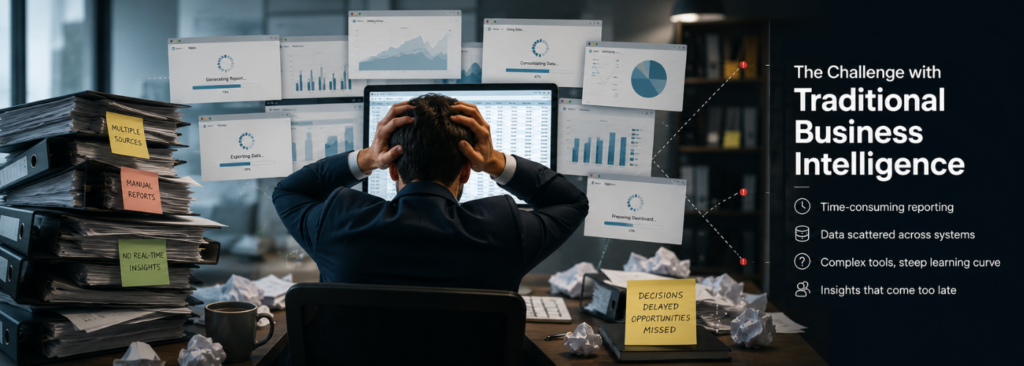
The Challenge with Traditional Business Intelligence

Business intelligence has evolved significantly over the years, but many organizations still face common challenges:

– Critical business data is spread across multiple systems.

– Teams depend on analysts or IT for custom reports.

– Dashboards answer predefined questions but often don’t address follow-up queries.

– Decision-makers spend valuable time searching for information instead of acting on it.

Modern businesses need more than reports—they need answers, delivered instantly and in context.

Meet Cazper

Cazper is an AI-powered Business Intelligence Assistant that transforms how organizations interact with their business data.

Instead of navigating multiple reports or writing complex queries, users simply ask questions in natural language and receive meaningful, real-time answers.

Whether your data resides in ERP systems, CRM platforms, finance applications, or operational databases, Cazper connects securely with your business systems to provide contextual insights that support faster and more confident decision-making.

Imagine asking questions like:

1. Which customers generated the highest revenue this month?

2. What are our overdue receivables?

3. Which sales opportunities are at risk?

4. How does this month’s performance compare with last month?

5. Which products are driving the highest revenue this quarter?

Instead of searching through dashboards, Cazper delivers the answers in seconds.

Designed for Every Business Leader

Business insights shouldn’t be limited to technical users.

Cazper is built for executives, managers, and teams who need quick access to reliable information without relying on complex reporting tools.

Whether you’re a CEO reviewing company performance, a finance leader monitoring cash flow, a sales manager tracking pipeline health, or an operations head identifying process bottlenecks, Cazper helps you make informed decisions faster.

Why Conversational Business Intelligence Matters

The way we interact with technology has changed dramatically. We ask virtual assistants for directions, search the web using natural language, and increasingly rely on AI to simplify everyday tasks.

Business intelligence is following the same path.

Instead of learning reporting tools or navigating countless dashboards, professionals can now interact with enterprise data through simple conversations. This shift—known as conversational business intelligence is making analytics more accessible across organizations.

By reducing the gap between people and data, businesses can respond faster, collaborate better, and make more informed decisions.

Why We Built Cazper

At Mismo Systems, we’ve spent years helping organizations modernize their data platforms and unlock greater value from business intelligence.

Throughout this journey, one challenge remained consistent: accessing information was often more difficult than using it.

We created Cazper to remove that barrier.

Our vision is simple to enable every business user, regardless of technical expertise, to access trusted business insights through natural conversations. By making analytics intuitive and accessible, Cazper empowers organizations to spend less time searching for data and more time making decisions that drive growth.

Discover Cazper

Cazper represents the next step in how businesses interact with their data combining the power of artificial intelligence with the simplicity of natural language.

If you’re looking to reduce dependency on manual reporting, accelerate decision-making, and make business intelligence more accessible across your organization, Cazper is built for you.

To learn more about Cazper, explore its capabilities, or request a personalized demonstration, visit the Cazper website and discover how conversational AI is transforming business intelligence.

FAQs

An AI-Powered Business Intelligence Assistant is a conversational AI solution that helps users access business insights using natural language. Instead of creating reports or navigating dashboards, users simply ask questions and receive real-time, data-driven answers.

Conversational business intelligence allows users to interact with business data using natural language instead of traditional dashboards or reports. It makes analytics more accessible, helping users find answers quickly and make data-driven decisions.

Cazper provides instant access to trusted business data, reducing the need for manual reporting and dependency on technical teams. This enables leaders to make faster, more informed decisions based on real-time insights.

Cazper integrates securely with a wide range of enterprise systems, including ERP, CRM, finance applications, data warehouses, and operational databases, allowing users to access insights from multiple data sources in one place.