
The Data Revolution Behind Every Journey
Travel businesses generate data at almost every stage of the customer and operational journey. Bookings, sales, finance, suppliers, destinations, routes, and distribution channels all create information that can help businesses understand performance and identify opportunities.
The challenge is no longer simply having access to data. It is connecting that data, understanding what it means, and turning it into better business decisions.
This is where Travel Analytics is becoming increasingly important.
Travel analytics helps airlines, hotels, travel agencies, tour operators, destination management companies, and other travel organisations bring together business information to understand performance, identify trends, improve planning, and uncover opportunities.
As data volumes continue to grow and AI changes how businesses interact with information, travel analytics is moving beyond traditional reporting towards more connected and predictive decision-making.
What Is Travel Analytics?
Travel analytics is the use of business data to understand performance, identify trends, and support decision-making across the travel and tourism industry.
Travel businesses may have information across booking platforms, CRM systems, finance applications, supplier systems, sales platforms, and operational tools. Looking at these sources separately provides only part of the picture.
Bringing this information together can help answer questions such as:
| Which destinations and markets are generating the most bookings?
| Which partners and channels are performing best?
| How is revenue changing?
| Which products or routes are performing well?
| Are cancellations increasing?
| What trends are likely to continue?
Travel analytics helps businesses move from “What happened?” to “Why did it happen?” and increasingly, “What could happen next?”
Why Is Travel Analytics Becoming So Important?

The travel industry does not stand still for very long. Demand changes with seasons, markets shift, routes evolve, supplier performance varies, and business conditions can change faster than expected.
For travel companies, this creates a constant need to make informed decisions quickly.
At the same time, many organisations are working with data spread across several systems. Sales may have one set of reports, finance may have another, and operations may use completely different information. Even when every team has the data it needs, bringing everything together can take time.
This is one reason Analytics in Tourism is becoming increasingly important.
The issue is often not a lack of data. It is the lack of a clear and connected view of that data.
When businesses can bring information together and make it easier to understand, teams spend less time searching for answers and more time using those answers to move the business forward.
9 Ways Travel Analytics Can Help Travel Businesses
1. Get a Clearer Picture of Business Performance
Travel businesses need to understand how different parts of the organisation contribute to overall performance.
Booking data can show transaction volumes, finance data can show revenue, sales data can reveal market performance, and supplier data can show partner contribution.
Connecting these sources gives businesses a broader view of revenue, bookings, destinations, channels, suppliers, and operations.
This can help answer questions such as:
– Which destinations are growing?
– Which markets generate the most revenue?
– Which channels perform best?
– Which partners contribute the most bookings?
The goal is not simply another dashboard. It is a clearer connection between business data and business decisions.
2. Understand Demand Before It Becomes a Problem
Travel demand is rarely consistent. Seasonality, changing customer preferences, destination popularity, and market conditions can all influence booking behaviour.
By analysing historical bookings, destination trends, and market performance, travel businesses can better understand how demand is changing.
Predictive analytics can take this further by helping organisations forecast potential demand and plan capacity, inventory, resources, and commercial strategies.
It cannot eliminate uncertainty, but it can give businesses more context when planning for what comes next.
3. Find Revenue Opportunities Hidden in the Data
Revenue opportunities may be hidden within booking patterns, destinations, products, suppliers, customer segments, or sales channels. Travel analytics can help identify these patterns.
For example, a travel company may discover that a particular destination performs better through one channel, or a hotel group may identify properties that consistently generate stronger results.
These insights can help businesses make more informed commercial decisions based on actual performance rather than assumptions.
4. Spend Less Time Looking for Answers
A simple business question can sometimes require hours of manual reporting.
A manager may want to know revenue by destination. An analyst may need to collect information from different systems, prepare the data, create a report, and then answer follow-up questions.
Modern analytics can make trusted business information easier to access and explore.
This can reduce repetitive reporting work and allow data teams to focus more on deeper analysis, data quality, and strategic initiatives.
5. Bring Disconnected Travel Data Together
Analytics should not be limited to data specialists.
Business teams need access to information that helps them understand performance and make everyday decisions.
Interactive dashboards and self-service analytics can allow teams to explore metrics such as bookings, revenue, destinations, suppliers, and sales channels without relying on a new report for every question.
The objective is not to replace analysts, but to make useful business information more accessible while allowing data teams to focus on higher-value analysis.
6. Make Data Easier for Business Teams to Use
Analytics should not be limited to data specialists.
Business teams need access to information that helps them understand performance and make everyday decisions.
Interactive dashboards and self-service analytics can allow teams to explore metrics such as bookings, revenue, destinations, suppliers, and sales channels without relying on a new report for every question.
The objective is not to replace analysts, but to make useful business information more accessible while allowing data teams to focus on higher-value analysis.
7. How AI Is Changing Travel Analytics
AI is changing how business teams interact with data.
Instead of navigating multiple dashboards or requesting a specific report, users can increasingly ask questions in natural language.
For example:
– Which destinations generated the most revenue this quarter?
– Which suppliers had the highest booking growth?
– Which markets are showing declining performance?
This can make analytics more accessible to people who do not work with data every day.
However, AI is only as useful as the data behind it. Reliable data, good governance, and well-designed analytics remain essential for trustworthy insights.
8. Move From Looking Back to Planning Ahead
Traditional reporting focuses mainly on what has already happened.
How many bookings were made? Which destination generated the most revenue? How did this quarter compare with the previous one?
These questions remain important, but travel businesses also need to understand what may happen next.
Predictive analytics can combine historical and current information to identify trends and support planning.
This can help businesses consider questions such as:
– Which destinations may see increasing demand?
– Which markets are gaining momentum?
– Where could performance decline?
– What changes should the business prepare for?
Predictive analytics does not provide certainty, but it gives businesses additional evidence and context for planning.
9. Measure B2B Travel Partnerships More Effectively
Travel is a highly interconnected industry. Airlines work with agencies and distribution partners, hotels work with travel companies and corporate partners, and tour operators depend on suppliers across multiple destinations.
With so many relationships involved, businesses need to understand which partnerships are creating the most value.
Analytics can help organisations look at partner contribution, booking volumes, revenue, destination performance, sales channels, and other business metrics to build a clearer picture of partnership performance.
This can make conversations with partners more meaningful because decisions are based on evidence rather than assumptions.
Instead of simply knowing that a partnership is performing well, a company can understand exactly where that performance is coming from and where there may still be room for improvement.
What Does the Future of Travel Analytics Look Like?

The future of travel analytics is not simply about having more dashboards or collecting more data.
It is about making business information more connected, more accessible, and more useful.
We are already seeing a shift towards analytics that can bring together information from different systems, make insights easier for business teams to access, and use AI to simplify the way people interact with data.
For travel businesses, this can lead to a very different way of working.
Instead of waiting for information to be prepared, teams can access it more easily. Instead of relying on assumptions, they can use actual business data to support decisions. Instead of looking only at past performance, they can start using insights to plan ahead.
And perhaps most importantly, analytics can become part of everyday business decision-making rather than something that is used only when someone needs a report.
The Future of Tourism Will Depend on Better Decisions

The future of tourism is often discussed in terms of new destinations, new technologies, changing demand, and new ways of doing business.
But behind all of these changes is something just as important: the ability to make good decisions.
Travel companies already have access to huge amounts of information. The real opportunity lies in turning that information into something their teams can actually use.
That is why travel analytics is becoming such an important part of the industry.
It can help businesses understand performance more clearly, identify opportunities earlier, plan with greater confidence, and respond more quickly when things change.
For B2B travel organisations, the goal is not to collect data simply for the sake of having more of it. The goal is to create a clearer connection between data and business action.
Because at the end of the day, data only becomes valuable when it helps someone make a better decision.
And as the travel industry continues to evolve, that ability may become one of the biggest advantages a business can have.
Turn Your Travel Data Into Business Insights
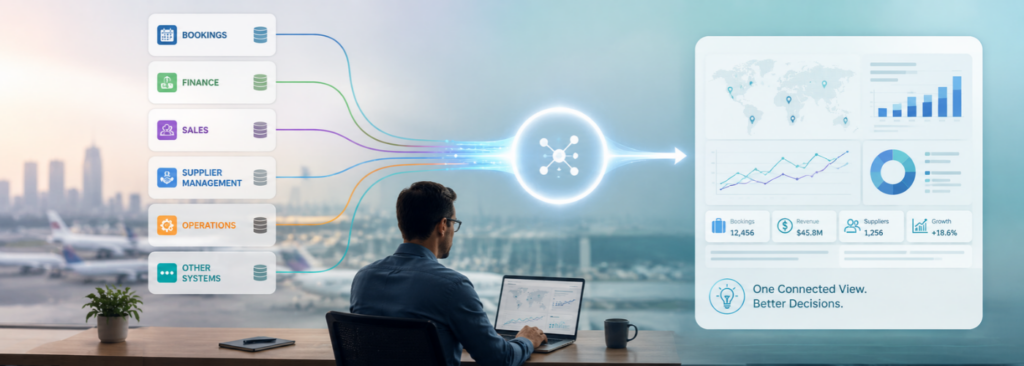
Your travel business generates valuable data across bookings, sales, suppliers, destinations, finance, and operations. The real opportunity is bringing this data together to understand performance, uncover opportunities, and make better business decisions.
Mismo Systems is a Microsoft Solution Partner with over 10 years of experience helping organisations build modern data and analytics solutions. As a Microsoft Solutions Partner for Data & AI, we bring expertise in Power BI, Advanced Analytics, and AI to help businesses turn complex data into actionable insights.
From improving travel reporting and analysing booking and revenue trends to understanding supplier performance and enabling AI-powered business intelligence, we help you turn your travel data into insights your teams can act on.
Ready to get more value from your travel data?
FAQs
Travel Analytics is the process of using business data to understand performance, identify trends, and make better decisions. It can bring together data from bookings, sales, revenue, routes, suppliers, destinations, and operations to give travel businesses a clearer picture of what is happening.
Travel Analytics can help tourism businesses understand demand, track revenue, analyse routes and destinations, measure supplier and partner performance, improve operations, and identify new business opportunities. It helps teams move beyond simply looking at numbers to understanding what those numbers actually mean.
Analytics can highlight which destinations, routes, products, partners, or sales channels are performing best. By spotting these patterns, businesses can identify revenue opportunities, improve commercial planning, and focus resources where they can have the most impact.
AI makes it easier for business teams to interact with their data and get insights faster. Instead of relying only on fixed reports, teams can ask business questions in natural language and explore relevant information more easily, provided the answers are grounded in reliable business data.
The travel industry is becoming more data-driven and interconnected. As businesses deal with growing volumes of information across different systems, the ability to turn that data into clear, actionable insights will become increasingly important for better planning, faster decisions, and long-term growth.